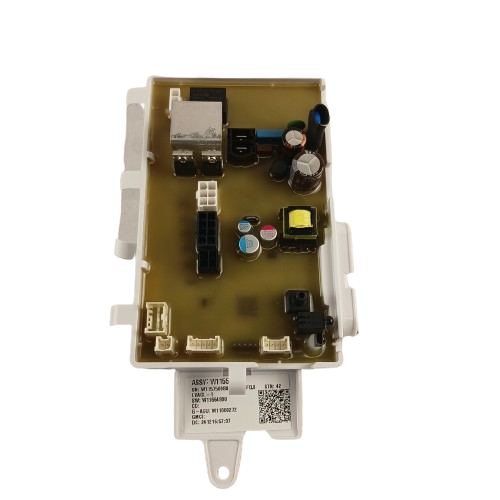
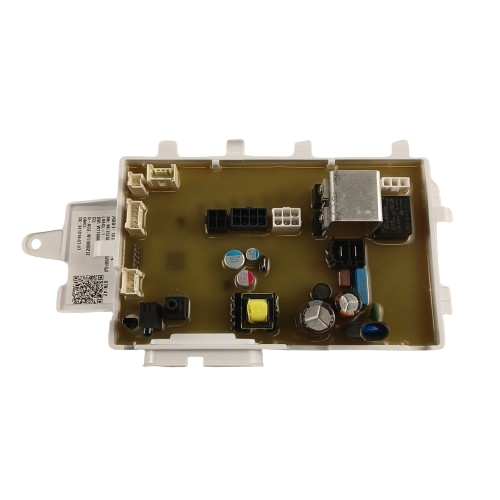
The W11633362 is a genuine OEM Whirlpool washer electronic control board (also called ACU Program Assembly or main control board) designed for Whirlpool, Maytag, Kenmore, KitchenAid, and Amana top-load washing machines. This critical component is the "brain" of the washer, controlling all washer functions including cycle selection, water fill, agitation, drain, spin, and error detection. The electronic control board receives input from the user interface panel, water level sensors, temperature sensors, and other components, then sends commands to the motor, water valves, drain pump, and other systems to execute the selected wash cycle. The control board is essential for proper washer function—without a functioning control board, the washer cannot operate. The W11633362 is rated for 120V AC operation and is designed to provide reliable, consistent control for efficient washing performance. The washer electronic control board is a complete assembly that includes all components necessary for installation. The washer electronic control board is constructed from premium materials including a high-quality printed circuit board (PCB) with multiple layers (provides electrical pathways and component mounting), microprocessor or microcontroller chip (executes washing program logic and cycle control), power supply circuitry (converts 120V AC to DC voltages for board operation), relay switches (control high-current devices like motor, pump, and valves), capacitors and resistors (provide electrical filtering and signal conditioning), electrical connectors and terminals (provide secure connection to washer wiring harness, user interface, sensors, and actuators), protective plastic housing (protects the PCB from moisture, vibration, and physical damage), mounting bracket and hardware (secures board to washer cabinet), and integrated diagnostic LED indicators (provide troubleshooting information for technicians). The W11633362 features a compact design that mounts inside the washer cabinet, typically behind the control panel or on the side panel near the top of the washer. The board has multiple electrical connectors that plug into the washer wiring harness, connecting to the user interface panel, motor, water valves, drain pump, door lock, water level sensors, temperature sensors, and other components. When the user selects a wash cycle and presses start, the control board executes the programmed cycle sequence, controlling water fill levels, wash and rinse temperatures, agitation speed and duration, drain timing, spin speed and duration, and error detection and display. The W11633362 replaces older control board part numbers and features improved microprocessor design for faster cycle execution and more reliable operation, enhanced power supply circuitry for better voltage regulation and surge protection, upgraded relay switches for longer lifespan and reduced contact wear, improved electrical connectors for better conductivity and corrosion resistance, optimized PCB layout for better heat dissipation and reduced electromagnetic interference, and enhanced diagnostic capabilities for easier troubleshooting across all compatible washer models. The washer electronic control board operates through digital logic and electrical switching: when the user selects a wash cycle and presses start, the user interface sends signals to the control board; the control board microprocessor reads the cycle selection and user options (temperature, soil level, spin speed, etc.); the control board executes the programmed cycle sequence; the board sends commands to the water inlet valves to fill the tub to the correct level; the board monitors water level sensors to detect when the tub is full; the board sends commands to the motor to agitate or tumble the clothes at the correct speed; the board monitors cycle timing and advances through wash, rinse, and spin phases; the board sends commands to the drain pump to drain water; the board sends commands to the motor to spin the drum at high speed to extract water; the board monitors sensors for errors (unbalanced load, door open, water overflow, etc.); if an error is detected, the board stops the cycle and displays an error code; when the cycle is complete, the board stops all operations and signals completion. Common failure causes include normal wear from age and continuous operation (typical control board lifespan 8-15 years with average use), power surges or voltage spikes damaging electronic components, water damage from leaks or moisture intrusion, relay contact wear from repeated switching, capacitor failure from age or heat stress, solder joint failure from thermal cycling and vibration, manufacturing defects, or premature failure from low-quality replacement boards. When the washer electronic control board fails, symptoms include washer will not start (no power to board or board failure, most common symptom), washer displays error codes continuously (board malfunction), washer stuck on one cycle phase (board not advancing cycle), washer fills but will not agitate or spin (board not sending motor commands), washer overfills or underfills (board not reading water level sensors), washer control panel buttons not responding (board not reading user interface), washer runs erratically or skips cycle phases (board logic failure), burning smell from control panel area (board overheating or electrical failure